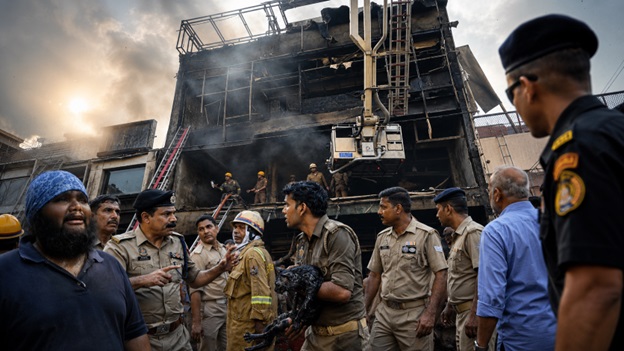
Lucknow: The devastating fire that tore through a commercial building in Lucknow’s Aliganj area has once again exposed a painful truth: in India, fire safety often becomes an afterthought until tragedy strikes. The blaze, which claimed the lives of at least 15 people—many of them young students and workers—has left families shattered and raised uncomfortable questions about how such disasters continue to occur despite repeated warnings.
According to preliminary investigations, the three-storey building housed a coaching centre, gaming zone, and other commercial establishments. Reports suggest that the structure lacked critical fire safety clearances and suffered from serious violations, including a single narrow staircase, inadequate escape routes, and poor emergency preparedness. As smoke rapidly engulfed the premises, panic spread among occupants. Some reportedly succumbed to suffocation, while others jumped from upper floors in desperate attempts to escape.

The arrest of four building owners has followed a familiar pattern seen after almost every major fire incident in the country. There is public outrage, official inquiries, compensation announcements, and promises of strict action. Yet, after a few weeks, attention fades, enforcement weakens, and another tragedy waits to happen elsewhere.
The Lucknow incident is far from an isolated case. Across India, fires in hospitals, hotels, shopping complexes, coaching centres, factories, and residential buildings continue to reveal the same alarming shortcomings. Buildings operate without valid fire clearances. Electrical systems are overloaded beyond capacity. Emergency exits are blocked or converted into storage areas. Fire extinguishers remain unserviced or non-functional. Safety drills are rarely conducted, and many occupants have little idea how to respond during an emergency.
Ironically, India is not short of regulations. The National Building Code clearly lays down detailed fire and life safety requirements. The challenge lies in implementation. Compliance is often treated as a bureaucratic formality rather than a life-saving necessity. Safety certificates are sometimes obtained through questionable means, inspections are irregular, and violations frequently go unchecked until disaster exposes them.
Experts have repeatedly stressed that every commercial, educational, institutional, and public assembly building must adopt basic safety measures without delay. Multiple exit routes are among the most critical requirements. Buildings with only one staircase become death traps when smoke blocks the sole escape path. Fire detection systems, including smoke alarms and heat sensors, can provide precious minutes for evacuation. Fire extinguishers, sprinkler systems, fire pumps, and wet risers are equally essential, especially in larger structures.
Equally important is the design of the building itself. Fire-resistant doors, compartmentalized spaces to slow the spread of flames, and clearly marked refuge areas can significantly improve survival chances. Illuminated exit signs, emergency lighting, and evacuation maps should be standard features rather than optional additions.

However, infrastructure alone cannot guarantee safety. Regular evacuation drills and trained staff are vital. In many fire incidents, confusion and panic cause as much harm as the flames. Occupants often lose valuable time because they do not know where exits are located or how to respond when alarms sound.
Responsibility for ensuring compliance does not rest solely with building owners. Municipal authorities, fire departments, urban development agencies, and local administrations must strengthen enforcement mechanisms. Random inspections, digital monitoring systems, strict penalties, and the sealing of unsafe premises should become routine rather than exceptional measures.
Another critical issue is the approval process itself. Most commercial and public buildings require fire department clearances, electrical safety certifications, and structural stability certificates before occupancy. High-rise and specialized buildings must additionally install advanced systems such as sprinklers, smoke extraction units, fire lifts, and external hydrants. Yet investigations into past tragedies have frequently uncovered missing, expired, or even fraudulent certifications.
While authorities have a major role to play, citizens cannot afford to remain passive. Parents enrolling children in coaching centres, families visiting malls, movie theatres, restaurants, or hotels, and employees working in commercial buildings should pay greater attention to visible safety measures. Checking for emergency exits, observing whether corridors are obstructed, and noticing the presence of functional firefighting equipment are simple but potentially life-saving habits.
The broader solution lies in creating a culture where safety is considered non-negotiable. Licensing norms must be strictly enforced, with no occupancy permitted until compliance is verified. Technology can assist through real-time monitoring systems and automated alerts. Educational institutions, offices, and public venues should conduct mandatory quarterly fire drills. Urban planning must ensure wider access roads for emergency vehicles and prevent excessive strain on electrical infrastructure. Most importantly, legal action against negligence must be swift and meaningful enough to deter future violations.


 ---------------------------------------------------------------------------------------------------